


Nagasaki marks 81st anniversary of atomic bomb as nuclear war fears rise
Nagasaki marks 81st anniversary of atomic bomb as nuclear war fears rise

Jack Hobbs Mon, August 10, 2026 at 1:28 AM UTC
0
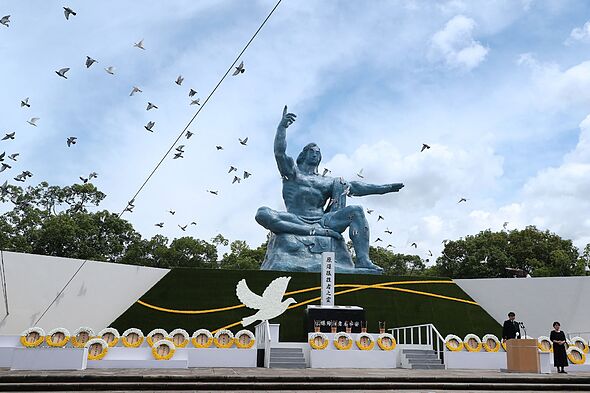
People pray for the victims at Urakami Cathedral on the 81st anniversary of the Nagasaki A-Bomb dropping (Image: The Asahi Shimbun via Getty Images)
Residents of the Japanese city of Nagasaki commemorated the 81st anniversary of the U.S. dropping the atomic bomb on Sunday as fears of nuclear war continue to dominate the political landscape.
It was reported that this year, the anniversary coincided with Japanese Prime Minister Sanae Takaichi's government revising the country's defense policy, which would further bolster the country's military offensive capability. The revisions come amid speculations about whether or not Takaichi, who supports nuclear deterrence, would allow nuclear weapons to enter the country.
During the memorial to the 70,000 casualties, Mayor Shiro Suzuki denounced the use of nuclear weapons, calling them "absolute evil," and denounced the growing support of nuclear deterrence, and urged the Japanese government to adhere to its three previously established postwar non-nuclear principles.
Russia's chilling WW3 threat to reduce Germany and Finland 'to dust'
Trump quietly weighed 'finishing the job' in Iran as Vance spills new strategy
"The theory of nuclear deterrence is extremely dangerous and fragile," warned Suzuki. "Nuclear weapons are not a 'necessary evil' but an 'absolute evil,' and can never coexist with humanity."
"To all leaders of the nuclear states and nations relying on nuclear deterrence, you must face the reality that the more you rely on nuclear deterrence, the more you increase the risk of a nuclear war," Suzuki added.
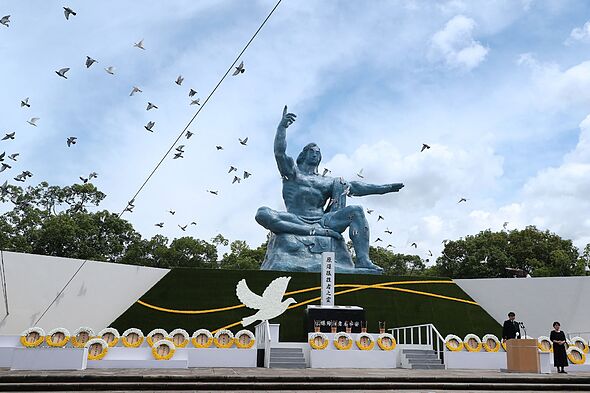
Doves are released after the Peace Declaration is delivered by Nagasaki City Mayor Shiro Suzuki (Image: Getty)
It was reported that during the observance in Peace Park, more than 90 representatives from various countries attended and all participated in a moment of silence at 11:02 a.m., when a B-29 dropped a plutonium bomb, known as "Fat Man."
The prime minister, who attended the observance, reiterated her policy of taking a "realistic and pragmatic approach" to achieving a world without nuclear weaponry.
In her speech, Takaichi was careful not to mention the Treaty on the Prohibition of Nuclear Weapons, but later told reporters that Japan's policy is to work within the framework of the Nuclear Nonproliferation Treaty.
Advertisement
Many survivors have slammed the county's support for nuclear deterrence as being insincere. Growing concern for Takaichi's possible easing of the non-nuclear principles has prompted protests in both Hiroshima and Nagasaki.
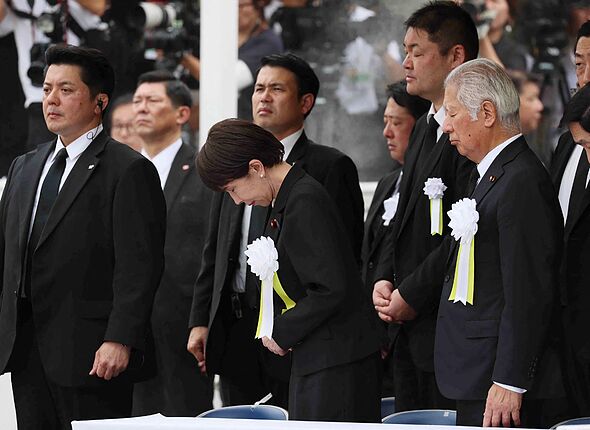
Japanese Prime Minister Sanae Takaichi (C) bows during a ceremony at the Peace Memorial i (Image: JIJI Press/AFP via Getty Images)
It comes as the U.S. has begun rewriting its nuclear strategy as war with both Russia and China seems to inch ever closer.
According to an exclusive NBC News report, Defense Department policy chief Elbridge Colby is drafting the new strategy, where nuclear weapons are concerned, involving shorter-range tactical munitions.
The outlet spoke to five sources familiar with the plans led by Colby, which are said to depart from decades of U.S. nuclear doctrine.
The sources say the new draft "emphasizes the possible use of shorter-range tactical weapons in case of a regional war with China or Russia."
DON'T MISS:
Russia makes chilling WW3 nuclear threat warning to rest of the world
Putin's alleged space weapon plan that could wipe out global infrastructure
North Korea sparks all-out war fears with plans for two new warships annually
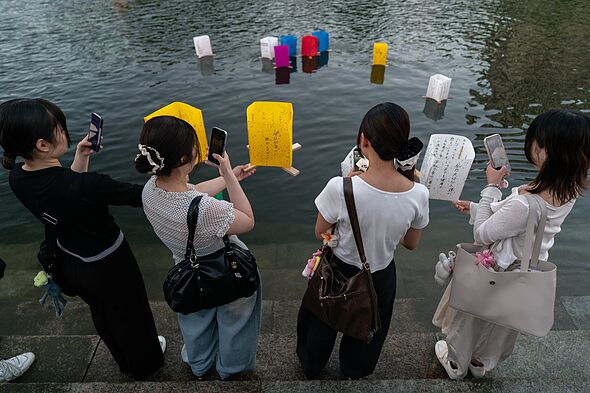
The younger generations were also involved (Image: Getty Images)
It focuses on tactical options, with shorter-range weapons specifically designed for battlefield use, rather than the weaponry used in Cold War deterrence, such as a long-range arsenal. The main goal, if such a war were to happen, would be to prevent it from turning into a full nuclear exchange and to prevent either China or Russia from exploiting a moment when Washington's attention was focusing on the other.
Among the primary concerns regarding China is a possible invasion of Taiwan in an effort to seize control of the territory. On Wednesday, August 5, Taiwan launched its annual military drills to practice responding to a potential Chinese invasion of the self-ruled island, which Beijing regards as part of its territory.
The live-fire exercises are intended to evaluate the Taiwanese military's capacity to maintain round-the-clock defensive operations and to respond to China's "gray-zone tactics," which fall just short of direct military confrontation. Urban preparedness drills will assess how the population handles disruptions to internet connectivity.
Source: “AOL Breaking”
